SAFCell Farewell & Thank you!

After 21 years of determination, ingenuity and excellent teamwork, SAFCell has come to an end.

The fuel cell, hydrogen, and energy landscape have changed drastically since opening our doors, with many existing technologies now commercialized, albeit a few decades later than initially thought. And yet, the need for very pure hydrogen and inability to run directly on liquid fuels remains a barrier to mass adoption of many technologies on the market.

As such, the intermediate temperature technology of Solid Acid Fuel Cells and Solid Acid Hydrogen Generators still remains a viable option for future commercial systems, especially for devices that will run on green liquid hydrogen carriers whose production is being rapidly increased to provide green fuels and chemicals for a high energy, low carbon future.

We ESPECIALLY wanted to thank all the support, interest, investment, and encouragement from everyone involved in our journey: the SAFCell (and Superprotonic!) team, academic collaborators, government bodies and government laboratories, industry partners, and of course, our investors. We cannot express our gratitude enough for the multiple decade long support and encouragement you gave us, without which we would never have been able to take the technology from a pile of white powder to products tested and deployed on three continents.

~ Calum Chisholm
SAFCell, Japanese energy company ENEOS Corp. ink JDA for solid acid fuel cell development

SAFCell and Japanese energy company ENEOS Corporation have finalized a joint development agreement (JDA). Under the agreement the two companies will work together to improve the electrochemical efficiency of SAFCell's solid acid fuel cell, with a view toward developing and producing megawatt-scale direct methylcyclohexane (MCH) solid acid fuel cells for use in stationary applications such as power plants. Commenting on the JDA, ENEOS’s Innovation Technology Center General Manager Dr. Yasushi Sato noted that “SAFCell's technology holds great potential for the development of direct MCH fuel cells for use in stationary applications. Their technology aligns well with the supply chain system ENEOS is developing, and we look forward to this partnership."

ENEOS is investing in a supply chain system for cost-effective production and transportation of hydrogen as a carbon-free fuel using MCH as a hydrogen carrier. SAFCell's proprietary technology uses solid acid electrochemical cells capable of converting MCH into electricity (as a direct MCH fuel cell) or hydrogen (as an MCH hydrogen generator). SAFCell has successfully demonstrated and ENEOS has tested this technology at small scale. Through the JDA, SAFCell and ENEOS aim to lay the groundwork for large-scale applications.

SAFCell CEO Dr. Calum Chisholm also cited the complementary technologies between the two companies. "We are excited to partner with ENEOS as we shift to running our fuel cells and hydrogen generators on renewable fuels. Liquid hydrogen carriers like MCH are the key to decarbonizing both the power grid and hard-to-electrify sectors like heavy duty trucking and shipping. If our joint goals for this partnership are realized, SAFCell is ready to scale to serve these large power and hydrogen generation markets," remarked Chisholm.

About SAFCell

SAFCell Inc. develops solid acid fuel cell and hydrogen stacks for portable, stationary and mobile applications, all running on commercially available liquid fuels. SAFCell's technology permits on-site generation of electricity or compressed hydrogen from all leading renewable liquid hydrogen carriers (LHCs) in one efficient and low-cost step — unlocking green hydrogen's potential to replace hydrocarbons in energy sectors worldwide.

About ENEOS Corp.

ENEOS Corporation is the largest oil company in Japan and is now trying to establish a carbon dioxide-free hydrogen supply chain with MCH as a hydrogen carrier. ENEOS’s Direct MCH® technology enables the production of green MCH from water, toluene and renewable electricity in a single step and is an efficient and low-cost alternative to the conventional two-step process.

SAFCell CEO Dr. Calum Chisholm to speak at Caltech Entrepreneurs Forum Sat. June 4th

SAFCell founder and CEO Dr. Calum Chisholm will speak at his alma mater Caltech’s Entrepreneurs Forum on Saturday June 4th. The theme of the event is decarbonizing energy, and Dr. Chisholm will present an overview of how SAFCell’s technology integrates with liquid hydrogen carriers to promote the growth of the green hydrogen economy.

Formed in 1984, the Caltech Entrepreneurs Forum is an entrepreneurship resource of Caltech’s Office of Technology Transfer and Corporate Partnerships. The mission of the Caltech Entrepreneurs Forum is to encourage the growth and success of technology-based entrepreneurial ventures in Southern California.

SAFCell, Naval Research Laboratory sign CRADA for exploration of new class of solid acid proton conductors

SAFCell Inc. has signed a Cooperative Research and Development Agreement (CRADA) with the Department of the Navy's U.S. Naval Research Laboratory (NRL). CRADA is an agreement between a Federal laboratory and a non-Federal party to perform collaborative research and development in any area that is consistent with the Federal laboratory's mission.

Under the terms and within the scope of the agreement, SAFCell will provide expertise and guidance for the development and testing of a new class of borosulfate solid acid intermediate-temperature proton-conducting materials, and evaluate these experimental electrolytes in electrochemical cells.

"SAFCell is excited to work with NRL to develop electrochemical devices using NRL's borosulfate electrolytes,” SAFCell’s Chief Executive Officer, Calum Chisholm said. “These solid state proton conductors can operate at higher temperatures and without the hydration requirements of our current electrolytes, which equates to more versatile and lower cost solid acid systems.”

Read the full NRL press release here.

CERAWeek panel discussion recap: Accelerating development of zero-carbon energy systems for deep decarbonization

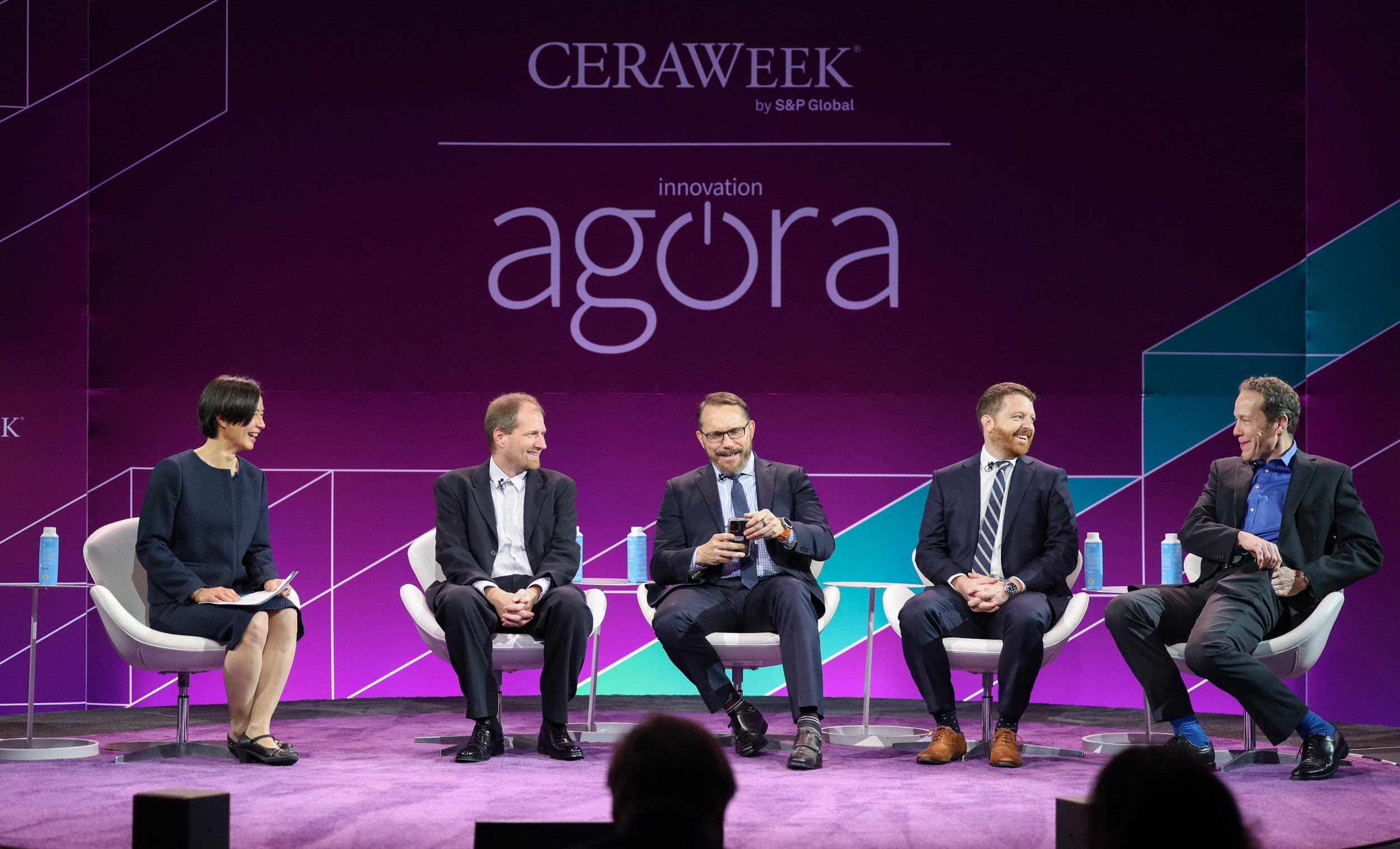
On March 9th SAFCell president and CEO Dr. Calum Chisholm participated in a panel discussion with three other clean energy entrepreneurs to offer their perspectives on the key challenges that must be overcome to develop zero-carbon energy systems and technologies at scale. The consensus was that these challenges are not just technological—changes in policy-making and legislation, and alignment with the evolving investment climate, must also be taken into account.

The event, moderated by Carolyn Seto, Director of Upstream Technology & Innovation at S&P Global, was part of CERAWeek's Energy Innovation Pioneers (EIP) program. EIP highlights the companies and entrepreneurs involved in developing technologies and business plans that are transforming the energy future. To view a recording of the panel discussion, click here.